
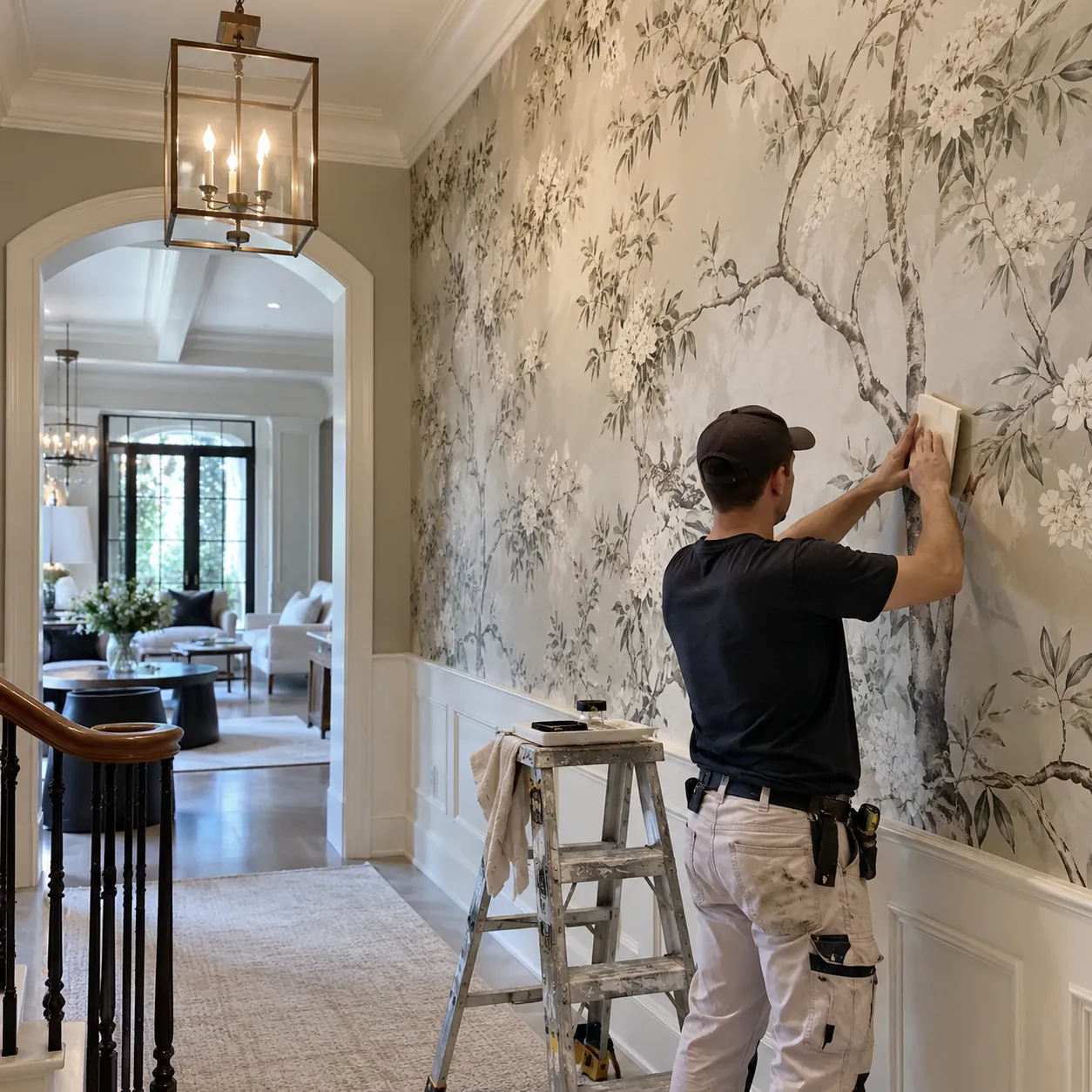
You picked the paper. We make it look like it was printed on the wall: true plumb lines, a balanced layout, matched seams and tight cuts at every edge.
What a professional wallpaper installation includes
Good wallpaper work is mostly decisions made before the first strip goes up. On every job we start by reading the room: which wall the eye lands on first, where the pattern should be centered, where the last strip will meet the first, and which corners are out of plumb. Those choices decide whether a room looks custom or just covered.
- Layout planning. We center large motifs on focal points such as a bed wall, fireplace or vanity, and hide the final mismatch in the least visible corner.
- Wall prep and primer. Patching, sanding and a wallcovering primer suited to the paper. Primer helps the paste grip, gives us slip time to line up seams and makes future removal far easier.
- The right paste for the material. Paste-the-wall nonwovens, paste-the-paper traditional papers, prepasted papers and heavy vinyls each need a different adhesive and technique.
- Pattern matching. Straight, drop and random matches, measured off a plumb line on every wall rather than off the previous strip.
- Clean detail work. Trimmed edges at ceilings, baseboards, door and window casings, outlets and switch plates, with no overlaps or gaps.
- Clean up. Floors protected throughout, paste washed off trim, scraps removed and leftover rolls labeled for future repairs.
Wallpaper types we hang
We install almost every residential wallcovering on the market. A few of the most common in Puget Sound homes:
| Type | What it is like to hang | Where it works well |
|---|---|---|
| Nonwoven | Dimensionally stable, usually paste-the-wall, strips off dry later | Most rooms, rentals, first-time wallpaper |
| Traditional paper | Paste-the-paper, needs booking time, can stretch when wet | Designer prints, period homes |
| Vinyl and vinyl-coated | Heavier, scrubbable, needs a stronger adhesive | Kitchens, laundry rooms, hallways |
| Prepasted | Activated with water; still benefits from primer and careful seams | Bedrooms, budget-friendly projects |
| Peel-and-stick | Repositionable at first, sensitive to texture and paint sheen | Small accent areas, renters |
| Grasscloth, cork, metallic, silk | Delicate, visible seams by nature, no paste on the face | Feature walls, dining rooms, offices — see grasscloth installation |
How we keep seams invisible
Most visible seams come from three things: walls that were not primed, paper that was over-stretched while wet, and seams that were rolled too hard. We prime with a product made for wallcoverings, follow each manufacturer's soaking or booking time, butt the seams instead of overlapping them, and set them with a light roller or brush. On papers prone to shrinking we check seams again as the paste cures.
If a wall has a texture such as orange peel or knockdown, it can show through thin papers. We will tell you during the estimate if a skim coat is worth it — our wall prep and skim coat service covers that.
Supplying the wallpaper
Most clients buy their own wallpaper from a showroom, designer or online store. Before you order, send us the product link or label. We check the roll size, pattern repeat and match type and tell you how many rolls the room really needs, plus a spare roll from the same batch. You can also run the numbers yourself with our wallpaper roll calculator.
What is included
- Photos, measurements and wallpaper reviewed first
- Roll count checked before you order
- Furniture moved and floors protected
- Patching, sanding and wallcovering primer
- Plumb layout and pattern-matched seams
- Outlet covers, vents and fixtures removed and reinstalled
- Clean-up and labeled leftovers
Planning wallpaper installation in Seattle and the Eastside
A wallpaper installation project starts long before the first roll is opened. The room, the wall surface, the material and the pattern all shape how the work is planned, how long it takes and what has to happen first. This section covers the practical side: what we look at, how each room type changes the approach, how pattern match affects ordering, and what to send so the estimate reflects the real job.
What shapes the job
No two rooms hang the same way, even with the same paper. These are the factors we weigh when we review your photos and measurements:
- Substrate. New drywall, painted drywall, plaster, paneling and previously papered walls each need different preparation before paste goes on.
- Material. Weight, stretch, paste method and how forgiving the face is when handled all change the pace of the work.
- Pattern repeat and match. A large repeat produces more waste per strip and takes more time to align across corners and openings.
- Openings and interruptions. Windows, doors, built-in shelving, radiators, wall-mounted fixtures and sloped ceilings add cuts and planning.
- Access. Stairwells, two-story entries and tall walls need ladders, planks or scaffolding, and more care moving strips into place.
- Room condition on install day. Whether the room is empty, furnished or still under construction affects setup and sequencing.
Pattern match and why it matters for ordering
The match type printed on the roll label tells you how one strip lines up with the next. It also changes how much paper the room needs, which is why we ask for the product details before you order.
| Match type | How strips line up | Effect on waste and layout |
|---|---|---|
| Random match | Any strip can sit next to any other | Lowest waste; strips are often reversed to even out shading |
| Straight match | The design lines up horizontally at the same height on every strip | Moderate waste, depending on the repeat length |
| Half-drop match | Every other strip is shifted down by half the repeat | Higher waste; strips are often cut from two rolls in rotation |
| Multiple-drop match | The design steps down across three or more strips | Careful sequencing and the most planning time |
Our guide to dye lots and ordering explains why all rolls should come from the same batch and why one spare roll is worth having.
Room-by-room notes
Bedrooms and living rooms. Usually the most straightforward rooms. The main decision is whether to paper one feature wall or the whole room, and where the pattern should be centered relative to the bed, sofa or windows.
Bathrooms and powder rooms. Small rooms with many cuts around vanities, mirrors, toilets and towel bars. Fixtures that can be removed safely are taken down and reinstalled. Ventilation matters here; our article on wallpaper in kitchens, bathrooms and laundry rooms covers material choices for damp spaces.
Kitchens and laundry rooms. Short wall sections between cabinets and above counters, plus backsplash edges. Washable or scrubbable material is usually the practical choice.
Hallways and stairwells. Long runs where a small error in plumb becomes obvious by the far end. Stairwells need staging so strips can be hung in one piece from ceiling to stair stringer.
Ceilings. Overhead work is slower and needs a different setup. See ceiling wallpaper installation for how we approach it.
Our installation sequence on the day
- Confirm the layout with you: starting point, centerline and where the final seam will land.
- Check every roll for batch number, print quality and damage before cutting.
- Lay out strips in order and cut with allowance at the top and bottom for trimming.
- Apply paste following the manufacturer's method for that material.
- Hang each strip to a plumb line, butt the seams and smooth out air.
- Trim at ceiling, baseboard and casings, then wipe paste from the face and trim.
- Walk the room with you once the walls are done and check seams in good light.
Common installation problems and how they are avoided
Most problems people notice after a DIY attempt trace back to a small set of causes. Pattern that drifts downhill across a wall comes from hanging off the previous strip instead of a fresh plumb line. Shading differences between strips usually mean mixed batches or strips hung in the wrong direction. Gaps that open days later point to paper that was stretched while wet. Lifting edges near the ceiling or baseboard often mean paste was not worked fully to the edge or the wall was dusty. Each of these is prevented by planning and technique rather than by the paper itself. If you do see bubbles in the first days, our article on wallpaper bubbles after installation explains what is normal while the paste dries.
Tip: keep the roll labels or take a photo of them before installation day. The batch number, match type and repeat on the label are needed later if a section ever has to be repaired.
Who we work with
Our wallpaper installers work for homeowners updating a single room, interior designers who need specified paper hung to their layout, property managers preparing units, and general contractors who need a wallpaper contractor scheduled after paint and before final trim. For offices, retail spaces and hospitality interiors, see commercial wallpaper and wallcovering installation.
What to send for an estimate
- Photos of each wall, including corners, windows, doors and any existing wallpaper
- Wall widths and ceiling height, or a simple sketch with dimensions
- The wallpaper link or product name, roll size and pattern repeat
- Your timeline and whether other trades are working in the room
We review the wall condition, material and pattern repeat, visit if needed and send a written estimate. To start your wallpaper installation, send photos, measurements and wallpaper details through our contact page or call (206) 380-4118, every day from 7 am to 10 pm.
Recent projects
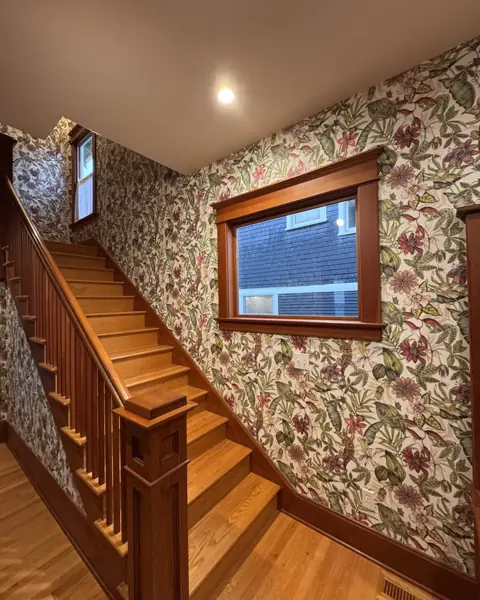
Questions about wallpaper installation
How long does it take to wallpaper a room?
A typical accent wall takes a few hours once the wall is prepped. A full bedroom is often one day, and rooms that need wallpaper removal, repairs or primer drying time can take two. Stairwells, ceilings and grasscloth take longer. You will see the schedule in your estimate.
Do I need to buy the wallpaper before the estimate?
No. You can request the estimate first so the measurements and roll count are confirmed. If you already have the paper, keep it in its packaging and check that all rolls share the same batch or lot number.
Can you hang wallpaper I bought online?
Yes. We hang paper from showrooms, designers and online stores. Send the product link so we can check the material, paste type and pattern repeat ahead of time.
Do you install peel-and-stick wallpaper?
Yes. Peel-and-stick looks best on smooth, clean walls with a satin or eggshell paint. On textured or freshly painted walls we may recommend a primer or a different product so it does not lift.
Can wallpaper be installed in a room that is still being remodeled?
Wallpaper should go up after drywall, paint on ceilings and trim, and most dusty work are finished. We can coordinate timing with your contractor so the walls are ready and primed when we arrive.
Should I remove outlet covers and wall fixtures before you arrive?
You do not need to. We remove outlet and switch covers, vents and fixtures that can be safely taken down, and reinstall them after the paper is hung.
Can you hang wallpaper on only part of a wall, such as above wainscoting?
Yes. Wallpaper above wainscoting, below a chair rail or inside framed panels is a common layout. We plan the cut line and pattern placement so the design sits evenly along the trim.
Helpful guides
Local pages
Where we offer wallpaper installation
Seattle and surrounding cities: