
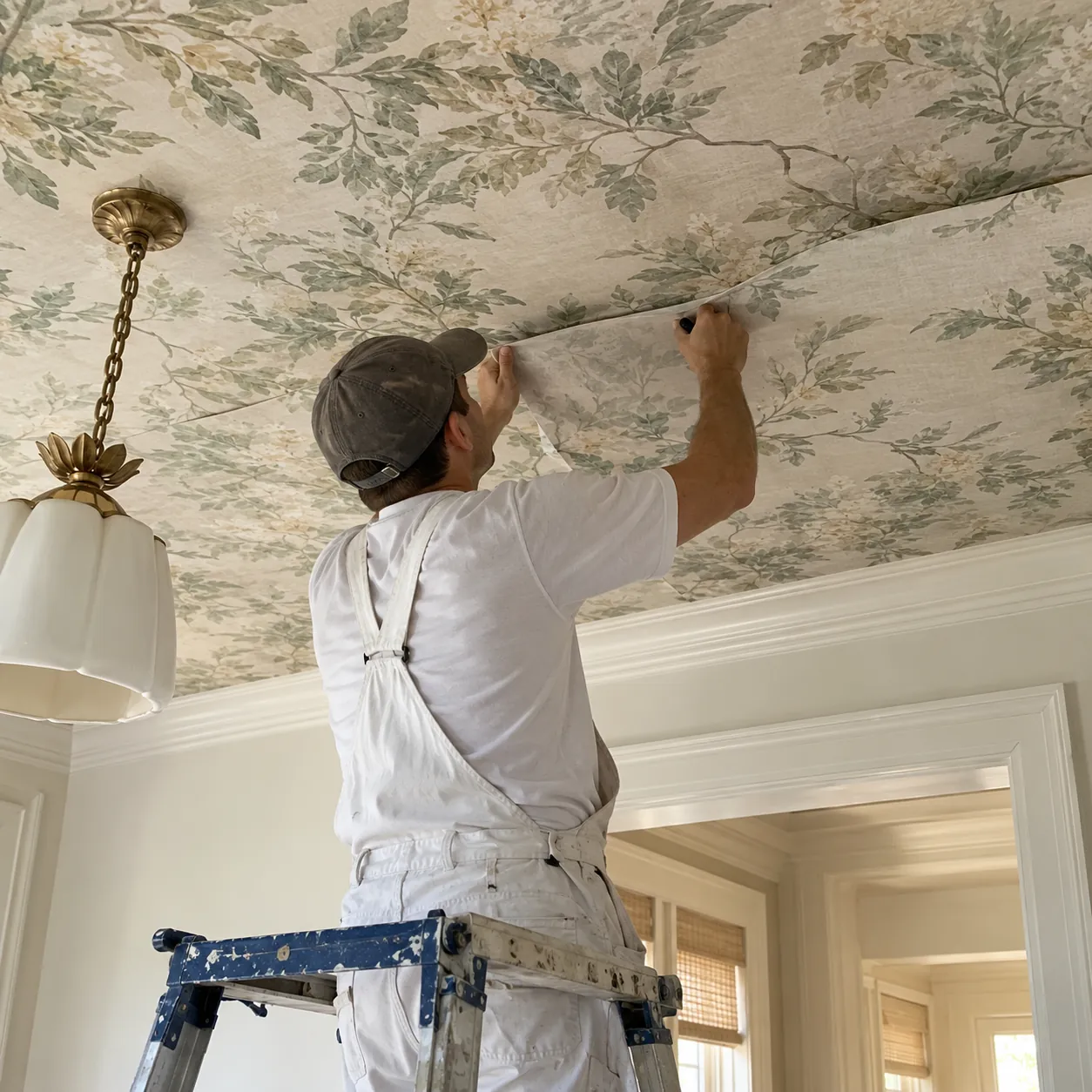
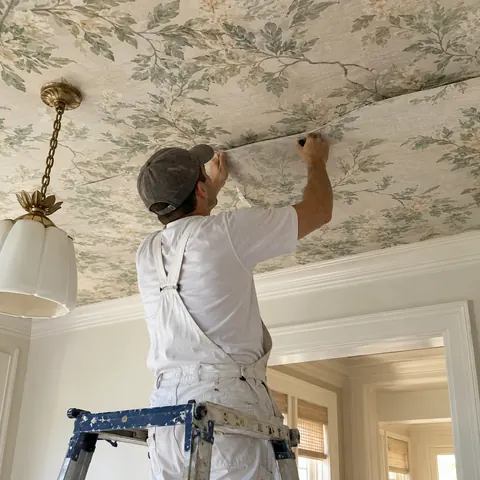
Wallpaper on a ceiling turns a plain room into a finished one. It is also the hardest place to hang paper: heavy wet strips overhead, no room for sloppy seams and lights that rake across every flaw. That is exactly why it is worth hiring out.
Ceilings that look great with wallpaper
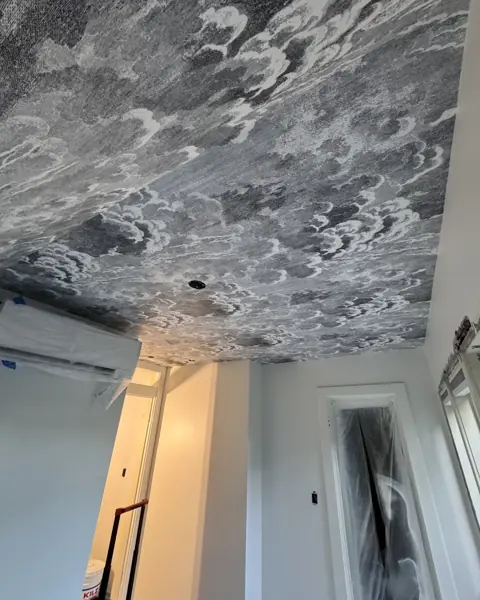
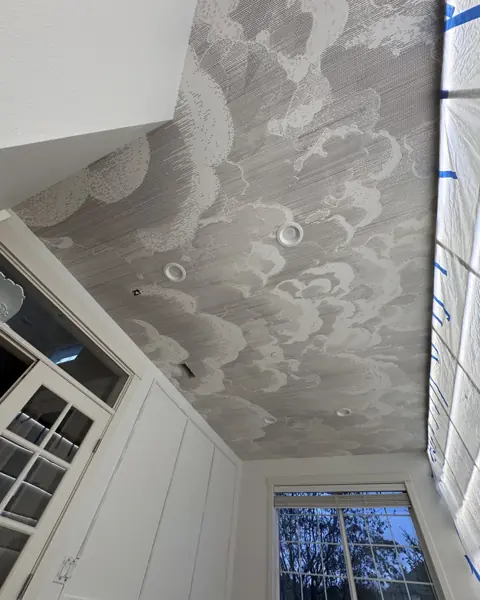
Powder rooms, dining rooms, nurseries, bedrooms, sunrooms, closets and entry halls are common choices. Cloud and sky murals make a bedroom feel taller; a small floral turns a powder room into a jewel box; grasscloth or a subtle texture warms up a dining room. Ceiling paper also works well where the walls are busy with windows and trim and there is little wall space left to decorate.
How we wallpaper a ceiling
- Safe setup. Planks, ladders or rolling scaffold so we can walk the length of each strip.
- Direction and layout. Strips usually run across the shortest span to keep them manageable; the pattern is oriented to the main entrance or the way you will look up from the bed or table.
- Fixtures down. Light fixtures and vents are removed (power off) and the paper is cut cleanly around the boxes.
- Corners and walls. We decide whether the paper stops at the ceiling line, wraps onto the wall or meets crown molding, and trim it straight even if the ceiling is not.
- Lightweight, stable products. Nonwoven papers are easier to hang and keep overhead; we will tell you if a heavy or delicate paper is not a good match.
Prep for ceilings
Popcorn or heavy texture has to be removed or skim-coated first, and older ceilings may have hairline cracks that need repair. In older homes, popcorn ceilings can contain asbestos and should be tested before anyone disturbs them. After prep, a wallcovering primer helps the paper grab quickly overhead.
What is included
- Scaffold or plank setup
- Fixture removal and reinstall (power off)
- Ceiling repairs and primer
- Layout oriented to the room
- Clean edges at walls or crown
- Floor and furniture protection
- Final clean-up
Planning Ceiling Wallpaper Installation: What Shapes the Job
Ceiling wallpaper installation is planned differently from a wall project because gravity, light and access all work against the installer. Before we quote a ceiling, we look at five things: the surface the paper will go on, the wallpaper itself, the pattern and its repeat, the shape of the room, and how we will reach the work safely. Each of these changes the preparation, the time on site and sometimes the choice of paper.
The surface overhead
Ceilings in the Seattle area range from smooth plaster in older houses to orange peel or knockdown drywall in newer homes and condos. Smooth, sound plaster is often a good base once it is cleaned and primed. Knockdown and heavier orange peel usually show through thin papers, especially when a ceiling light shines across them, so a skim coat is often recommended. Our guide to skim coating before wallpaper explains when that step is needed. Water stains, sagging tape joints and nail pops are repaired and sealed before any paper goes up, because the wallcovering will highlight them rather than hide them.
The material
Paper weight, backing and the adhesive method all matter more on a ceiling than on a wall. A pre-pasted or paste-the-wall nonwoven can be handled in shorter, lighter strips. Traditional papers that must be pasted and booked add weight and need careful timing. Natural materials such as grasscloth are possible on some ceilings, but seams and shading show more overhead; ask about the specific product before choosing one for a ceiling.
Pattern, Repeat and Layout on a Ceiling
On a wall, the eye reads a pattern from the floor up. On a ceiling, people look up from a doorway, a bed, a dining table or a tub, so the layout is planned from that viewpoint. A straight match, a half-drop and a random match each behave differently when the strips run across the room instead of top to bottom.
| Pattern type | How it reads on a ceiling | Layout notes |
|---|---|---|
| Small all-over prints | Forgiving; out-of-square edges are hard to spot | Good choice for powder rooms and closets with uneven ceiling lines |
| Stripes and geometrics | Show any drift against walls or beams | Need a careful centerline and a plan for where the last strip lands |
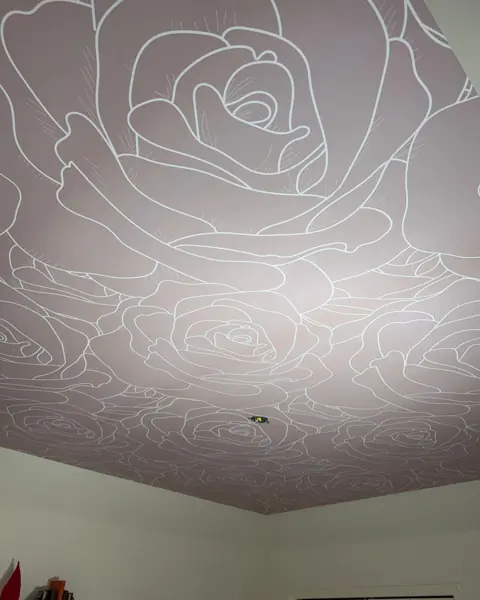
| Large florals and botanicals | Strong focal point; motif placement matters | Center a motif over the light fixture or the middle of the room |
| Murals and sky scenes | Panels must line up in a set order | Panel sequence and orientation confirmed before hanging; see wall mural installation |
Large repeats on a ceiling can use more material than expected, because each strip has to match the one beside it across the full span. Use the wallpaper calculator as a starting point, then send us the product details so we can check the repeat against the actual room size.
Ceiling Wallpaper by Room
- Bathrooms and powder rooms: Ventilation matters. A bath with a working exhaust fan is a better candidate than one where steam sits at the ceiling. We look at the fan location and the paper's moisture tolerance before agreeing on the plan.
- Bedrooms and nurseries: The layout is usually oriented to the bed. Smoke detectors, ceiling fans and recessed lights are marked on the plan so motifs do not end up cut in half in obvious places.
- Dining rooms: The chandelier is the natural center. Medallions, beams and coffers are noted in advance because each one adds cuts and seams.
- Stairwells and vaulted spaces: These need taller access equipment and sometimes a different strip direction. Sloped ceilings that meet walls at an angle require a decision on where the paper stops.
- Offices and retail spaces: Suspended tile ceilings are not suitable for wallpaper. Drywall ceilings in commercial interiors can be papered, with access and scheduling planned around business hours.
Common Ceiling Wallpaper Problems and How They Are Avoided
Most ceiling failures trace back to preparation or handling rather than to the paper itself. Edges that lift a few weeks later usually point to a dusty or unsealed surface. Visible seams under a ceiling light are often caused by texture that was not leveled. Bubbles can appear when paste is uneven or strips are stretched while being positioned overhead. Our guide on wallpaper bubbles after installation covers what is normal while paste dries and what is not.
A good wallpaper installer avoids these issues by priming with a product suited to the wallcovering, working in strip lengths the crew can control, keeping the room at a stable temperature while the paste cures, and checking every seam from below in the room's normal lighting.
Before ordering, buy one sample and tape it to the ceiling for a few days. Look at it in morning light, in the evening with lamps on, and from the spot where you usually sit. Ceiling paper often looks darker overhead than it does in your hand.
What to Send for a Ceiling Wallpaper Estimate
- A wide photo of the whole ceiling, taken from a corner of the room.
- Close-ups of the surface in raking light, plus any stains, cracks or texture.
- Photos of every fixture, vent, detector, fan and any crown molding.
- Room length, width and ceiling height, and whether the ceiling is flat, sloped or vaulted.
- The wallpaper link or product name, roll size and pattern repeat.
- Whether the walls are also being papered, and whether the paper should stop at the ceiling line or continue onto the walls.
If the ceiling still has old wallpaper or loose paint, mention it; it may need wallpaper removal or other wall preparation before installation.
Plan Your Ceiling Project
For ceiling wallpaper installation in Seattle and nearby cities, send photos, room measurements and your wallpaper details through the contact page, or call or text (206) 380-4118 between 7 am and 10 pm any day. We review the surface, the material and the pattern repeat, then prepare a written estimate.
Recent projects
Questions about ceiling wallpaper installation
Can you wallpaper a popcorn ceiling?
Not directly. The texture must be removed or skim-coated first. In older homes, have the popcorn tested for asbestos before it is disturbed.
Should ceiling wallpaper match the walls?
It can, but it does not have to. Many rooms pair a patterned ceiling with painted walls, or a textured ceiling with patterned walls. We can help you test samples in your light.
Is ceiling wallpaper more expensive?
Ceilings take longer per square foot than walls because of setup, overhead work and fixture cut-outs. Your estimate lists ceiling work separately so you can compare options.
Can a ceiling with recessed lights be wallpapered?
Yes. The trim rings are removed with the power off, the paper is cut around each opening and the trims are reinstalled over the cut edge. Send a photo of the light layout so the pattern can be planned around them.
Which way should wallpaper strips run on a ceiling?
Strips usually run across the shorter dimension so each one is easier to handle overhead. The final direction also depends on the pattern and the main viewpoint in the room.
Can wallpaper go on a bathroom ceiling?
It can when the room has good ventilation and the paper is suitable for humid spaces. We look at the exhaust fan, the shower location and the product before recommending it.
Helpful guides
Local pages
Where we offer ceiling wallpaper installation
Seattle and surrounding cities: