Quick answer
A skim coat is a thin layer of joint compound spread over a wall to make it smooth. You need one before wallpaper when wall texture, patches or damage would show through the paper — especially under thin, shiny, metallic or mural papers. Heavy textured papers can sometimes hide light orange peel without one.
Key points
- Orange peel and knockdown texture are common in houses built since the 1980s.
- Thin and reflective papers show texture the most.
- A skim coat usually takes two coats plus sanding.
- Primer goes on after the skim coat, before wallpaper.
What wall texture does to wallpaper
Wallpaper takes the shape of whatever is under it. On a textured wall, the paper rides over every bump, and low light coming across the wall reveals it as a pebbly surface. Seams are also harder to close tightly because the edges land on uneven ground.
Do you need a skim coat? A quick test
Hold a sample of your wallpaper flat against the wall at night and shine a flashlight or lamp across it from the side. If you can see the texture through the sample, the finished wall will look the same. Thick, matte and textured papers often hide light orange peel. Thin papers, murals, metallics, silks and high-contrast geometrics usually do not.
How skim coating works
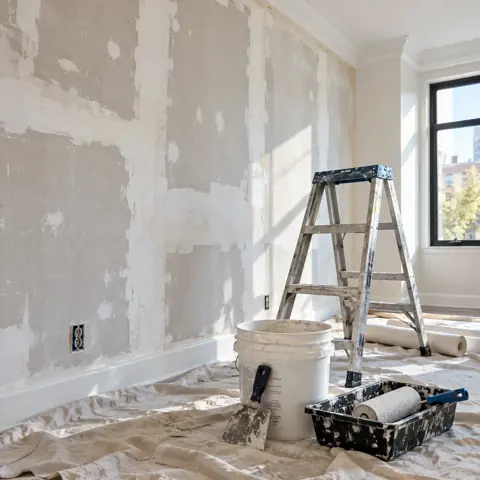
- Protect the room — floors, trim and outlets are covered.
- Knock down high spots and repair cracks, holes and loose tape.
- First coat: joint compound is rolled or troweled on and pulled tight with a wide knife, filling the low spots of the texture.
- Dry. Overnight in most homes; longer in cool, damp weather.
- Second coat at a different angle to fill what the first coat missed.
- Sand and clean until the wall is flat to the touch and free of dust.
- Prime with a primer suited to new joint compound and wallcovering.
How long it adds
For one accent wall, skim coating usually adds a day. For a whole room, plan one to two extra days for coats, drying and sanding. Fast-setting compounds can speed up the first coats, but the wall still needs to be fully dry before primer.
Other surfaces that need smoothing
- Torn drywall after wallpaper removal — sealed with a primer for damaged drywall, then skimmed.
- Plaster with cracks or patched areas in older homes.
- Paneling or beadboard — usually needs a liner or skim system, or removal.
- Old wall tile — generally removed rather than papered over.
Skim coat or liner paper?
Liner paper is a plain paper hung under the decorative paper to bridge small flaws. It can work on sound walls with fine cracks, but it does not flatten real texture the way a skim coat does. For heavy texture, a skim coat is the more reliable fix. Our wall prep service covers both.
Texture types common in Puget Sound homes
| Texture | What it looks like | Under wallpaper |
|---|---|---|
| Smooth (Level 5) | Flat, uniform surface | Ideal for any paper |
| Light orange peel | Fine bumps like citrus skin | Can work under thick, matte papers |
| Heavy orange peel | Pronounced bumps | Shows through most papers — skim recommended |
| Knockdown | Flattened splatter patches | Shows through — skim recommended |
| Plaster | Hard, sometimes wavy surface | Good once cracks are repaired and sealed |
Dust and drying in a damp climate
Joint compound dries by evaporation, and evaporation is slow in a cool, humid house — which describes many Seattle-area homes from October to May. Keeping the heat on and air moving shortens drying time. Sanding creates fine dust that settles on every surface; we contain the area, vacuum the walls and wipe them before primer, because dust left on the wall prevents the primer and paste from bonding.
Primer after skim coating
New joint compound is very porous. Without primer, it soaks water out of the paste, the paper grabs too fast and seams can lift. It also bonds the paste directly to the compound, which makes future removal destructive. A primer formulated for new drywall and wallcovering seals the surface so the paper goes on evenly and can come off cleanly later.
Is skim coating worth it?
If you are investing in a mural, a metallic or a high-contrast print, a skim coat protects that investment — the wallpaper will look exactly as it did in the showroom. On a busy, textured paper in a room with soft light, you may not need it. We will hold your sample against your wall during the estimate and tell you honestly which side of the line you are on.
FAQ
Can I just use thick wallpaper instead of skim coating?
Sometimes. Heavy textured papers can hide light orange peel. They will not hide knockdown or heavy texture.
Does a skim coat need primer before wallpaper?
Yes. New joint compound is porous and dusty; a primer seals it so paste bonds evenly and the paper can be removed later.
Can I skim coat a wall myself before the installer comes?
You can, but the wall must be truly flat, fully dry, sanded and dust-free. Uneven DIY skim coats can show through as badly as the original texture, so many clients include it in the installer's scope.