
Quick answer
Stairwells and two-story entries look dramatic with wallpaper, but they need scaffolding or planks, a plumb line on every wall and careful roll planning, because long strips mean fewer strips per roll. Patterns with a medium or large repeat and a strong vertical rhythm work especially well.
Key points
- Tall walls give fewer strips per roll, so order more.
- The pattern should be centered at eye level on the stairs.
- Stair walls have angled cuts along the stringer.
- Professional setup is needed for safety over stairs.
Why stairwells are worth it
A stairwell is one of the few walls in a home that people look at from top to bottom as they move. Wallpaper that carries from the entry up to the landing ties two floors together and makes even a plain staircase look designed.
Setup and safety
Stairs are not a safe place for a single ladder. We use step-ups, extension planks and stair-specific ladder setups so we can work at every height and handle long, wet strips safely.
Planning the pattern
- Choose the starting point. In a stairwell, the pattern is often centered on the most visible point — at the landing or opposite the front door.
- Keep the pattern level. The pattern should run level across the wall even though the stair line slopes.
- Plan the angled cut along the stair stringer or skirt board, and trim it straight.
- Watch the horizon. On long walls we check plumb on every strip, because a small drift becomes obvious over 16–20 feet.
Ordering for tall walls
A standard roll yields fewer long strips: a 33-foot roll may give only one or two full-height strips for a two-story wall, with a lot of leftover. Measure the tallest drop and use the calculator with that height, and plan to use leftover pieces above doors and below windows.
Patterns that work
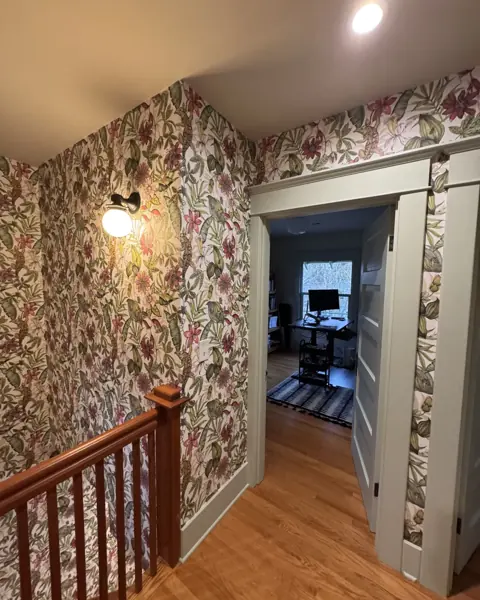
Medium and large florals, botanicals, trellis and ogee patterns and vertical stripes all suit tall walls. Very small prints can look busy across a big surface; random-match textures are the easiest to hang on a stair wall.
See our floral stairwell projects in the portfolio, and our installation service for how we work.
Where the pattern meets the stairs
Along the stair stringer, each strip is cut at an angle following the stairs. Those cuts are long and visible, so they are made with a straightedge and a fresh blade after the strip is fully set against the trim. At the bottom and top of the stairs, where walls change height, the pattern has to stay level so it lines up across the transitions.
Handling long, heavy strips
A wet strip 16 or 18 feet long is heavy and stretches easily. Paste-the-wall nonwovens are a big advantage here, because the strip goes up dry. With traditional papers, strips are booked carefully and often hung by two people — one above, one below — to avoid stretching or tearing the paper.
Landings, hallways and continuity
Most stairwells continue into an upstairs hallway or landing. Decide early whether the paper continues there, stops at an outside corner or changes to a coordinating paper. Continuing the paper creates a strong, unified look; stopping it at a logical corner keeps cost and rolls down.
Prep for stairwells
Stairwell walls get scuffed by hands, bags and moving furniture, and in older homes they often hide cracks and patched areas. We repair and prime the whole surface first, and recommend a washable or scrubbable paper where hands touch the wall along the stairs.
FAQ
Can you wallpaper a stairwell without scaffolding?
Short stair walls can be done with ladders and planks. Tall walls over stairs need proper setups for safety and quality.
How many rolls do I need for a stairwell?
It depends on the tallest drop and the pattern repeat. Tall walls use more rolls than the square footage suggests; we measure during the estimate.
What wallpaper patterns work best in stairwells?
Medium to large florals, botanicals, trellis patterns and vertical designs work well. Random-match textures are the easiest and waste the least on tall walls.