
Quick answer
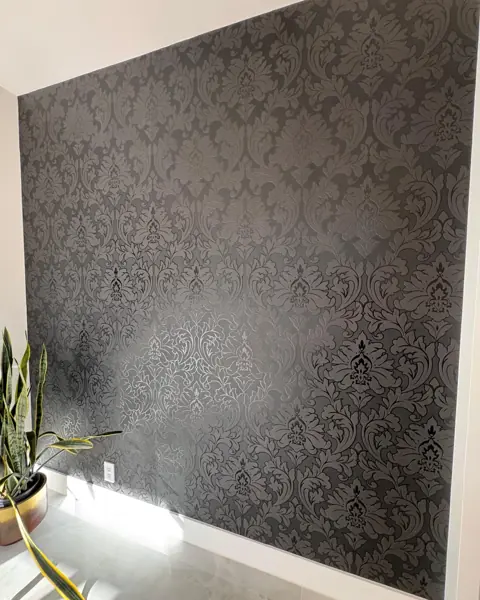
A repeating wallpaper prints the same pattern over and over, so it can cover any size wall and multiple walls. A mural is one large image printed in panels, sized to a specific wall. Choose a mural for a single focal wall with a scene or large artwork; choose repeating wallpaper for full rooms, hallways and walls with many openings.
Key points
- Murals are usually ordered to the exact wall size plus bleed.
- Repeating wallpaper is ordered by the roll.
- Murals show wall flaws more because the image is continuous.
- Walls with many openings suit repeating patterns better.
How they are made and sold
Repeating wallpaper comes on rolls. The design repeats at a set interval — the pattern repeat — and you buy as many rolls as the room needs. Murals are printed as a single image divided into numbered panels, either in fixed sizes or custom-sized to your wall.
Where each one shines
| Mural | Repeating wallpaper | |
|---|---|---|
| Best for | One focal wall, a scene, oversized art | Whole rooms, halls, stairwells |
| Openings | Fewer is better — doors cut into the image | Handles windows and doors well |
| Ordering | Exact size plus bleed | By roll count with waste |
| Wall prep | Very smooth wall needed | Smooth wall; busy prints forgive more |
| Changes later | Replace the whole mural | Spare rolls allow repairs |
Measuring for a mural
- Measure width at the top, middle and bottom; height at the left, center and right. Use the largest numbers.
- Add the bleed the printer recommends for trimming — usually a few inches on each dimension.
- Note where outlets, switches, vents and windows fall so you know which parts of the image will be cut.
- Decide where the focal point of the image should land: centered on the wall, the bed or a sofa.
We measure walls for mural clients before they order; see our mural installation service.
Popular mural uses
Scenic landscapes and watercolor city views in dining rooms, botanical and chinoiserie-style panels in powder rooms, kids' maps and storybook scenes in playrooms, and sky or cloud murals on ceilings. Commercial spaces use murals for branding and wayfinding.
Popular repeating-pattern uses
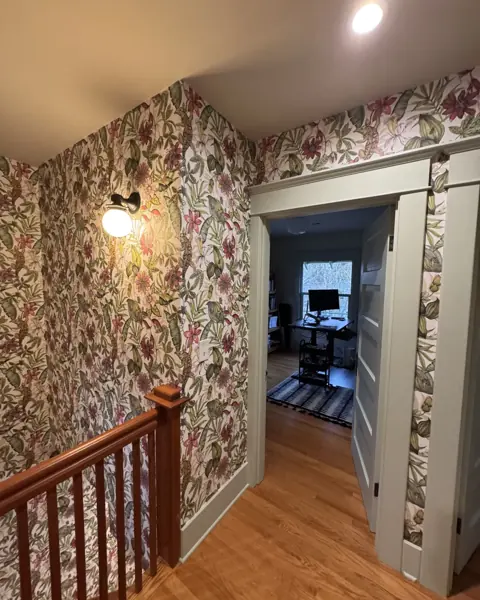
Florals in stairwells and halls where the pattern carries you from floor to floor, geometrics in small rooms that are wrapped on all walls, textures and grasscloth in living rooms and offices.
Ordering a custom-size mural
Many mural makers let you enter your wall size and adjust the crop of the image. A few tips from the installer's side:
- Do not crop tightly to the important part of the image — leave room for trimming at the ceiling and floor.
- Check where furniture will cover the image. A headboard or sofa can hide the best part of a scene.
- Make sure the panels are labeled with numbers and an arrow for "top".
- Ask whether the mural is paste-the-wall, paste-the-paper or peel-and-stick, and which adhesive is recommended.
- Ask about the overlap: some murals overlap panels slightly and are double-cut on the wall.
When a mural is the wrong choice
If the wall has a door in the middle, multiple windows, or will be mostly hidden by shelves or a large TV, the image will be cut into pieces and lose its impact. A repeating pattern handles those interruptions gracefully. Likewise, if you want to paper an entire room, a repeating paper is more practical than four separate murals.
Kids murals
Kids murals — maps, towns, forests, space scenes — are among the most fun projects we install. Choose a scrubbable or nonwoven product that can be wiped and later removed cleanly, and place the most interesting part of the image at a child's eye level, not up near the ceiling.
Repeating wallpaper that feels like a mural
Some large-scale repeating papers have repeats several feet tall, and on a single wall they read almost like a mural while still allowing you to paper around doors and windows. They are a good compromise for stairwells and entries where a single image would not fit.
FAQ
Can a mural go on more than one wall?
Yes, some murals are designed to wrap a corner, but the image will bend at the corner. Most murals look best on one flat wall.
Is a mural harder to install than wallpaper?
Murals need careful layout because one misaligned panel affects the whole image, but an experienced installer handles both routinely.
Can a mural be removed later?
Most nonwoven murals hung on a primed wall can be removed dry or with light soaking. Peel-and-stick murals peel off, though they can pull paint if the paint was not fully cured.