
Quick answer
DIY can work for a single accent wall with nonwoven or peel-and-stick paper on a smooth, primed wall. Hire a professional for expensive papers, grasscloth, murals, ceilings, stairwells, small rooms with many cut-outs, walls that need repair, and any room where old wallpaper has to come off first.
Key points
- Most DIY failures come from skipped prep, not hanging technique.
- Expensive or natural papers leave little room for practice.
- Ceilings and stairwells involve height and safety risks.
- A professional estimate can tell you what your walls need even if you DIY.
Projects that suit DIY
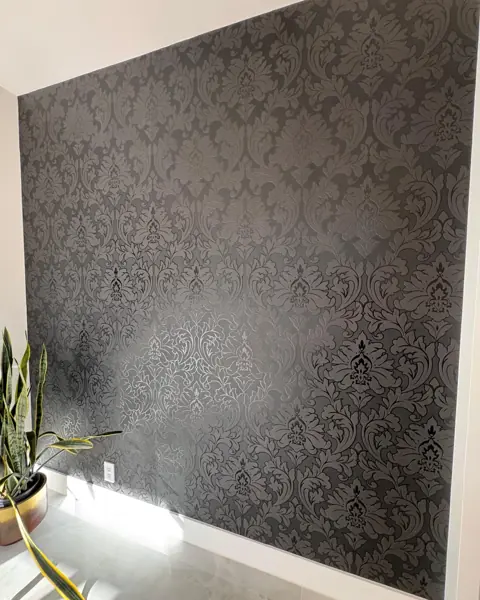
- One accent wall with a paste-the-wall nonwoven paper.
- Peel-and-stick paper on a smooth, clean, satin-painted wall.
- Small areas like the back of a bookshelf or a closet wall.
- Random-match or small-repeat patterns that are forgiving.
Projects best left to a professional
- Designer papers and grasscloth. A single mistake can waste a roll that costs more than the labor to hang it.
- Murals. One misaligned panel breaks the whole picture.
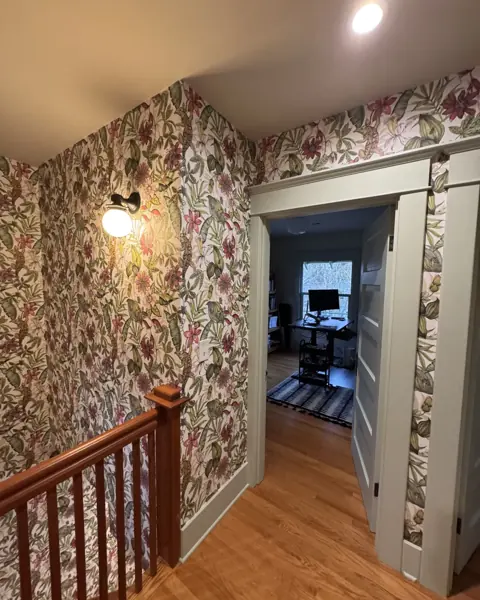
- Ceilings, stairwells and two-story entries. Height, scaffolding and long matched drops.
- Powder rooms and bathrooms. Toilets, pedestals, mirrors and many corners.
- Old wallpaper removal and walls that need repair or skim coating.
What professionals do differently
The difference is mostly in planning and prep. A professional checks the wall, primes it, decides where the pattern should be centered and where the last seam will land, and then hangs from a plumb line on each wall. They also have tools that are hard to justify for one room: laser levels, pasting tables or machines, wide trimming guides, scaffolding and a steady supply of fresh blades.
The costliest DIY mistakes
- Skipping primer — leading to lifting seams and drywall damage at removal time.
- Hanging over old wallpaper — leading to bubbles (see why wallpaper bubbles).
- Starting in a corner without a plumb line — the pattern drifts across the room.
- Not ordering enough rolls — a new batch may not match.
- Dull blades — torn edges at ceilings and trim.
A middle path
Some clients prep the room themselves — clear furniture, remove old nails, even remove strippable paper — and hire us for the hanging. Others ask us to handle removal and prep and then hang a simple accent wall themselves. We are happy to review your project and give honest advice either way. Call or text (206) 380-4118.
Tools for a DIY install
- Laser level or plumb bob and a long straightedge.
- Wallcovering primer and a roller.
- The right paste (if not prepasted), paste roller or brush and a tray.
- Smoothing brush and plastic smoother; a seam roller with a light touch.
- Snap-off utility knife with plenty of fresh blades and a wide trim guide.
- Clean buckets, sponges and lint-free cloths.
- A sturdy step ladder — and a clear head about heights.
Honest time expectations
For a first-timer, an accent wall that takes a professional a few hours often takes most of a day, and a full bedroom can take a weekend. Prep and cleanup take longer than most people expect. That is fine if you enjoy the process — just plan for it and do not start the night before guests arrive.
Where pros save money
Professional labor costs money, but it can save some too: fewer wasted strips, correct quantities, no damaged drywall when the paper comes off later and no rework. With expensive papers, the paper saved by careful layout and cutting can be a meaningful part of the labor cost.
Questions to ask any installer
- Do you include wall prep and primer in the estimate?
- Have you hung this type of paper before (grasscloth, mural, metallic)?
- How do you handle out-of-plumb walls and where will the last seam land?
- What do I need to do before you arrive?
- What happens if a seam lifts after the job?
We are happy to answer all of these when you request an estimate — call or text (206) 380-4118.
FAQ
Is it cheaper to wallpaper yourself?
You save on labor, but tools, wasted rolls and fixing mistakes can close the gap quickly — especially with expensive papers.
Can you fix a DIY wallpaper job?
Often, yes. Lifting seams and small bubbles can be repaired; badly misaligned or damaged strips may need to be replaced with spare paper.
What is the hardest part of hanging wallpaper yourself?
For most people it is keeping the first strip perfectly plumb and making clean cuts at ceilings and trim. Prep, though less exciting, matters even more.